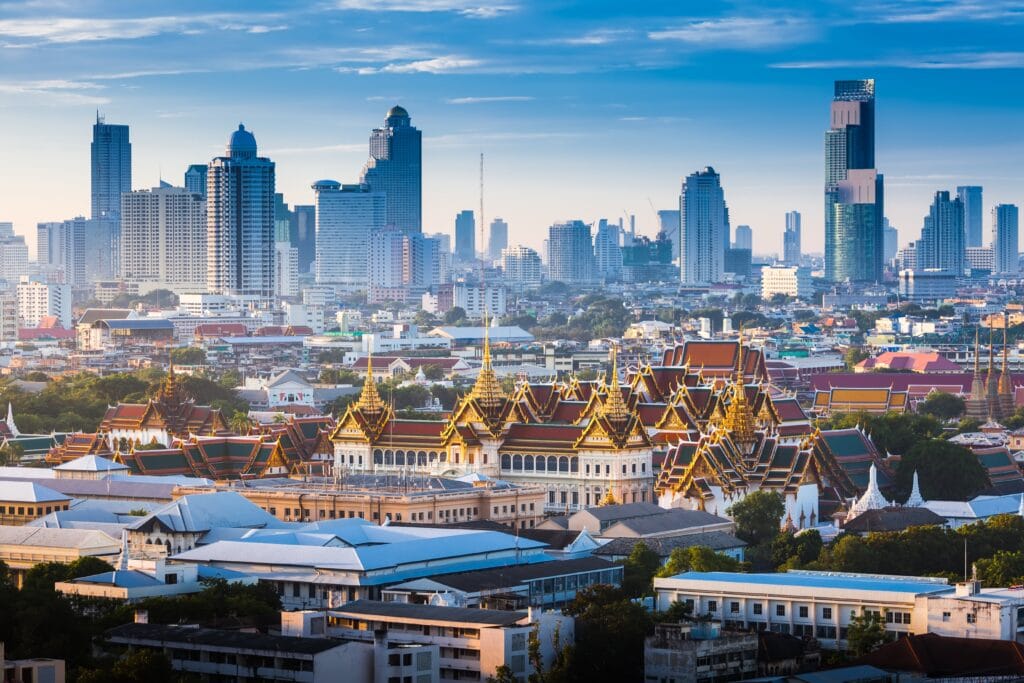
This guide is written for European travellers planning their first visit to Bangkok who want clear orientation and a calm comparison of neighbourhoods. It explains the practical differences between the city’s main areas—transport links, atmosphere, walkability and typical trade-offs—so you can match where you stay to how you intend to experience the city.
Orientation: Bangkok spreads along the Chao Phraya River with a dense central belt formed by Sukhumvit, Siam and Silom, and older districts around the river and Rattanakosin island that host most historical sites.
How Bangkok is laid out — a quick orientation
For a first visit, understanding Bangkok’s basic geography helps. The city divides roughly into the riverside and the inland grid. The BTS Skytrain and MRT subway create a north–south and east–west backbone across those inland areas; riverboats and ferries service the Chao Phraya. When considering where to stay in Bangkok first time, factor transit access above all: neighbourhoods with a BTS or MRT station shorten travel times dramatically and give a clearer base for exploring.
Sukhumvit (Asok, Thonglor, Ekkamai) — cosmopolitan living and easy transit
Sukhumvit is one of the best areas Bangkok for travellers who value a wide selection of restaurants, bars and easy public transport. The BTS runs along Sukhumvit Road, with Asok and Phrom Phong offering the most direct links to major shopping and transit hubs. Walkability varies: major intersections are busy and pedestrian crossings can be long, but elevated walkways and frequent BTS stations make getting around straightforward.
Vibe and trade-offs: modern, lively and expat-friendly. It suits visitors who want a metropolitan base with late-night dining options. The trade-off is that Sukhumvit can feel commercial and congested compared with riverside districts.
Silom and Sathorn — city skyline, night markets and a business centre
Silom and neighbouring Sathorn are Bangkok’s financial axis by day and an eclectic mix of nightlife and quiet hotel streets by night. Closely served by BTS (Sala Daeng) and MRT (Silom), these neighbourhoods provide fast connections to the cultural core and the airport rail link. Walkability is good between the parks and major streets, though smaller sois (side streets) can be narrow.
Vibe and trade-offs: polished yet diverse — office towers sit beside street-food lanes and night markets. This suits visitors seeking a compact base with a refined urban feel; the trade-off is less of the historic atmosphere found near the river.
Riverside and Phra Nakhon — landmarks, calm evenings and historical depth
The riverside and the old city (Phra Nakhon) are where Bangkok’s temples, palaces and quieter boutique hotels concentrate. Staying here places you close to the Grand Palace, Wat Pho and the serene river mornings. Transport is more mixed: several riverside hotels rely on riverboats and taxis, while the historic quarters are often best navigated on foot or by short taxi rides rather than by subway.
Vibe and trade-offs: atmospheric and slower-paced. It suits travellers prioritising cultural immersion and afternoon light on the river. The trade-off is longer transfers to shopping districts or nightlife clusters on Sukhumvit and Silom.
Siam and Pratunam — central, convenient and focused on shopping
Siam is Bangkok’s central transport and retail hub: the BTS interchange stations, large malls and direct access to the MRT make it a logical choice for a first visit. Pratunam, adjacent to Siam, is busier and more market-oriented. Both areas are extremely walkable for daytime exploration, though they become very crowded at peak times.
Vibe and trade-offs: highly central and efficient for sightseeing that spans multiple parts of the city. This suits travellers who plan a mixed itinerary of museums, shops and short-day trips. The trade-off is the commercial bustle and less of the traditional neighbourhood feel.
Khao San Road and Old City fringe — compact historic core and backpacker energy
The Khao San area and the immediate old city fringe are known for their concentration of budget guesthouses, lively bars and short-distance access to major monuments. Walkability is excellent within the old quarters, and many historic sites are best explored on foot. Public transport options are less direct: there is no BTS station in the heart of the old city, so expect taxis or a combination of river services and tuk-tuks.
Vibe and trade-offs: bohemian, informal and sociable. Ideal for visitors who want immediate access to the temples and night markets and who don’t mind a louder, younger street scene. The trade-off is limited high-speed transit connectivity compared with the BTS-served districts.
Practical travel tips
- Prioritise a neighbourhood with BTS or MRT access if your trip will visit multiple parts of the city; it reduces travel time and avoids peak-hour road congestion.
- For riverside mornings and calmer evenings, choose a hotel close to a Chao Phraya ferry pier; check whether the property provides a private boat shuttle for convenience.
- Consider street orientation: Bangkok sois (side streets) can be narrow and shaded; rooms facing inner courtyards are quieter but may have less natural light.
- Plan transfers from Suvarnabhumi or Don Mueang airports in advance. The Airport Rail Link connects directly to the city centre and joins BTS at certain stations; taxis are abundant but can be slower in rush hour.
- If mobility is a concern, select accommodation near an interchange (BTS + MRT) to minimise walking and transfers.
- Evenings: neighbourhoods like Silom and Sukhumvit have late dining options; riverside and old city areas offer earlier, more relaxed evenings.
- Local norms: dress respectfully when visiting temples (shoulders and knees covered); carry a scarf or sarong for quick coverage.
- Language: English is commonly spoken in central hotels and tourist areas, but learning a few basic Thai phrases improves everyday interactions.
FAQs
Which are the best areas Bangkok for a first visit?
For a first visit Bangkok typically falls into three practical bases: Sukhumvit for modern amenities and nightlife, Riverside/Phra Nakhon for temples and atmosphere, and Siam/Pratunam for central transit and shopping. Each offers a different balance of convenience and character.
Are Bangkok neighbourhoods safe for solo European travellers?
Central neighbourhoods such as Sukhumvit, Silom and Siam are generally safe and well patrolled; usual city precautions apply—watch personal belongings in crowded areas and avoid poorly lit side streets at night. The old city is busy and tourist-oriented but can be lively late into the evening.
How important is proximity to the BTS or MRT?
Proximity to the BTS or MRT is highly valuable on a first visit. These systems are fast, air-conditioned and bypass much of the city’s congestion, making daily sightseeing more efficient and predictable than relying solely on taxis or buses.
Which area is best for seeing historic sites and temples?
The riverside and Phra Nakhon hold the greatest concentration of historic sites such as the Grand Palace and Wat Pho. Staying nearby allows early-morning visits before crowds and a slower pace in the evenings.
Is Khao San a good choice for a short stay?
Khao San is excellent for immediate access to the historic core and a sociable, compact atmosphere. It is less ideal if you want seamless, rapid transit to other modern districts, since it lacks direct BTS or MRT service.
Conclusion
Deciding where to stay in Bangkok first time comes down to how you prioritise convenience versus atmosphere. Sukhumvit and Siam offer straightforward transit and contemporary comforts; Silom provides a refined urban balance; the riverside and old city reward those seeking cultural depth and quieter evenings; Khao San concentrates historic proximity and sociable energy. Each area presents clear trade-offs in terms of walkability, transport and mood, and the right choice depends on how you plan to spend your days in the city.
Recommended next:
- Where to Stay in Singapore CBD for Business and Leisure
- Best Boutique Hotels in Singapore for Design Lovers
- Luxury Hotels near Singapore MRT Stations
- Best Rooftop Pool Hotels in Singapore
- Best Areas to Stay in Singapore Without Breaking the Bank
- Where to Stay in Singapore for First-Timers: Simple Area Guide
- More in Singapore →