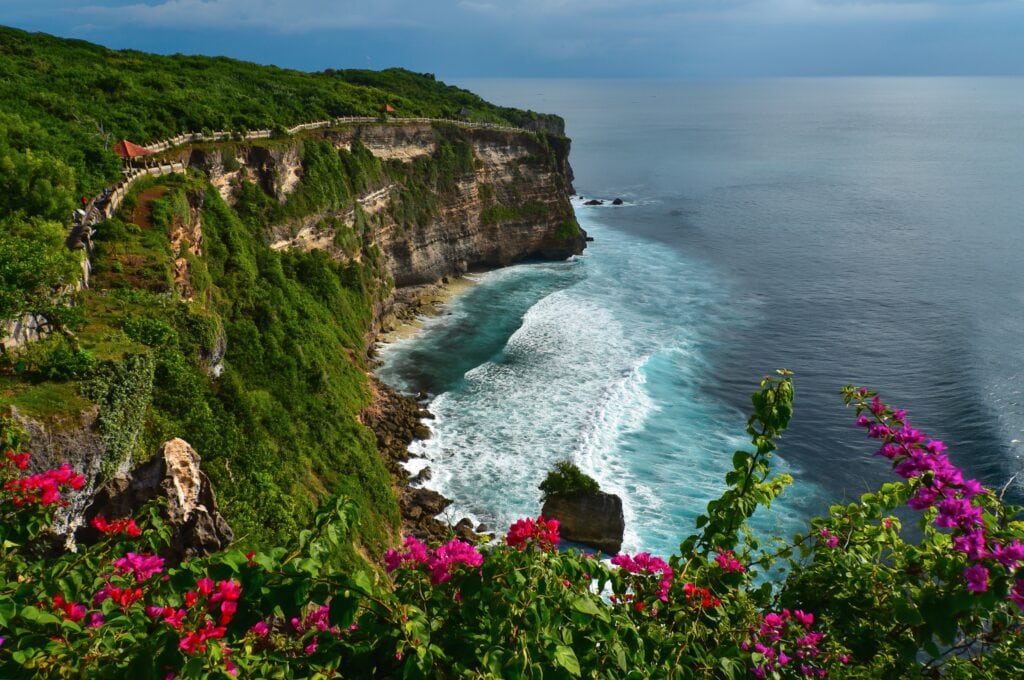
Uluwatu clifftop resorts for European travellers
For many European travellers, Uluwatu represents the Bali of imagination: sculpted cliffs, wide-sky sunsets and an ocean horizon that feels almost cinematic. Choosing to stay at uluwatu clifftop resorts is less about ticking off sights and more about immersing yourself in a slow, elevated coastal rhythm where days are structured around light, tide and tide-pools rather than city schedules.
This guide focuses on premium Uluwatu luxury resorts that pair panoramic sea views with private pools, cliff-edge infinity terraces and a sense of seclusion that still feels connected to Bali’s cultural landscape. It is written for travellers who value space, quiet and atmosphere over nightlife, and who want clarity on what the Bukit Peninsula’s southern tip really offers in terms of setting, movement and experience.
For orientation, Uluwatu sits on the southwestern edge of Bali’s Bukit Peninsula, about an hour’s drive from the airport, high above the Indian Ocean on limestone cliffs that step down towards some of the island’s most famous surf breaks.
Why Uluwatu’s clifftop setting is different from the rest of Bali
Many first-time visitors compare Uluwatu with more familiar Balinese areas such as Seminyak or Ubud, but the geography here fundamentally changes how you experience a stay. Uluwatu’s coastline is dominated by steep white cliffs and narrow coves, so uluwatu clifftop resorts feel more like eyries than beach hotels. You are not strolling directly onto a long flat shore; instead, you descend to pocket beaches via stairways and paths, then return to sweeping, wind-cooled heights.
This verticality has several implications. Views are exceptional and often uninterrupted, especially at sunset, when the sun falls directly into the ocean for much of the year. Breezes are stronger than in low-lying coastal districts, which helps temper Bali’s tropical humidity. On the other hand, Uluwatu is less walkable as a contiguous strip of sand or promenade. Resorts are often spread along the cliff road with some distance between them, and journeys between beaches usually involve short drives or scooter rides rather than casual seaside strolls.
For European travellers used to Mediterranean coasts, Uluwatu feels closer to a dramatic section of the Amalfi or Algarve than to a broad, urbanised beach. Distances on the map look short but can be deceptive because of winding roads and cliff access. This makes the on-property experience of uluwatu luxury resorts particularly important: you will likely spend more time enjoying the resort itself, the pools and onsite dining than you might in a more urbanised Balinese resort area.
Premium clifftop resorts & how they frame the sunset
Sunset is the primary “event” in Uluwatu, and the architecture of many uluwatu clifftop resorts is designed around this daily ritual. Rather than a single seafront frontage, you often have layered terraces, infinity pools and restaurants stepping down the cliff, each capturing a slightly different angle of the horizon.
At the most elevated properties, the main pool often occupies a prow-like position at the cliff’s edge. The sense of openness here is extensive; you see the curve of the coastline in both directions, watching waves break on the reef far below while the sky transitions from hard blue to layered oranges and mauves. Lower-set resorts, closer to sea level, offer a more intimate, wave-level perspective, with sunsets partially framed by headlands or neighbouring cliffs.
Because of the peninsula’s shape, many premium resorts have predominantly west-facing views, ideal for classic, symmetrical sunsets. Others are oriented slightly southwest, which brings more oblique light and shifting colours rather than a direct sun-drop. For travellers with a photographer’s eye, this differentiation matters. It is often possible to move between several vantage points on a single property—the main pool, a private villa terrace, a cliff bar—each giving a subtly different mood as evening progresses.
Music and atmosphere also vary. Some clifftop infinity pool hotels in Uluwatu maintain a calm, almost retreat-like ambiance with low-key playlists and soft lighting, while others lean into a more social, sunset-lounge style. For longer stays, Europeans who prefer quiet evenings often appreciate selecting a resort that emphasises space and acoustics as much as design.
Private villas and pools: what to expect from a cliff villa in Uluwatu
One of the distinctive draws of uluwatu luxury resorts is the availability of standalone villas with private pools, many positioned along the cliff contour or set into terraced gardens above the ocean. A typical cliff villa in Uluwatu pairs an indoor living space with sliding glass walls, a shaded outdoor deck and a plunge or lap pool that visually merges with the sea beyond.
Privacy levels differ considerably between properties. Some villas are fully walled on the sides with only the ocean-facing side open, creating an enclosed, almost sanctuary-like feel. Others are more open-plan, with neighbouring terraces partially visible across landscaped gardens. Those seeking maximal seclusion often look for villas that are staggered rather than aligned flat along a single level, reducing sightlines between pools.
Pool sizes also vary: in some villas, the pool is primarily for cooling off and framing photographs, while in others it is long enough for gentle laps. Depth is usually consistent at around chest height, but shallow tanning ledges or daybeds built into the water are increasingly common. Lighting plays a part too; many villas use subtle underwater or perimeter lighting rather than bright spotlights, helping maintain a tranquil atmosphere after dark.
Another consideration is how far your villa sits from the cliff edge. The most dramatic cliff villa Uluwatu experiences often involve a slight drop immediately in front of the pool, emphasising the sense of hovering above the sea. Further set-back villas typically offer more garden space and shelter from wind, which some travellers prefer for comfort and for families travelling with older children.
Infinity pools and the appeal of uluwatu infinity pool hotels
The defining image of many uluwatu infinity pool hotels is that seamless line where turquoise pool water appears to spill into the ocean. Infinity pools here are not purely decorative; they are central to the daily rhythm of a stay, especially for European guests who may spend longer on property between excursions.
The main resort pool is often positioned deliberately above the villas, maximising the sense of scale. From here, you can look down on the wave lines, reef breaks and, on clear days, even distant outlines of Bali’s volcanoes to the north. Sunbeds are typically arranged in tiers, with some shaded cabanas for guests who prefer to avoid the strongest midday sun. The trade-off for extensive views is exposure: winds on the cliff edge can be more noticeable during certain seasons, and the sun is particularly strong between late morning and mid-afternoon.
Several resorts also offer secondary, quieter pools set back from the cliff, sometimes surrounded by tropical vegetation rather than open sea. These can be appealing for guests who want the option of both drama and calm within a single property. In addition, some villas form part of a “pool tier” that cascades down the slope, so that each villa’s pool looks out over the next, ending in the main infinity edge.
Evenings around the pool are unhurried. Many properties dim lights and shift music towards softer tones as the sun sinks, reinforcing the sense that sunset is something to be observed rather than treated as background. For travellers used to more crowded Mediterranean hotel pools, the spatial generosity of Uluwatu’s cliff resorts often feels notably restful.
Location nuances: beaches, surf breaks and how you move around
Despite their elevated position, uluwatu clifftop resorts are closely tied to the beaches and surf breaks at their feet. However, access is rarely a direct, level stroll. In most cases, you either follow an internal path and staircase down the cliff or transfer by car or buggy to a beach access point nearby.
Each section of Uluwatu’s coastline has a slightly different character. Some bays are oriented more towards surfers, with reef breaks that can be powerful and less suited to leisurely swimming, especially at low tide. Others offer gentler conditions, with sandy entries and protected coves. The height of the tide matters: at high tide, beaches can feel narrow, with waves reaching close to the foot of the cliffs; at lower tide, rock pools and reef shelves become exposed.
For European visitors who enjoy exploring on foot, it is worth understanding that pavements are intermittent and distances between beaches—Padang Padang, Bingin, Uluwatu proper—tend to require brief rides rather than continuous seaside promenades. Many guests either arrange a car with driver for half days or hire a scooter if they are comfortable with local traffic conditions. Journeys to more central parts of Bali, such as Ubud or Canggu, are feasible as day trips but involve at least 60–90 minutes each way depending on traffic.
In return for this slight remoteness, Uluwatu retains a quieter evening rhythm and dark, relatively unpolluted night skies. Clifftop resorts often become their own small worlds after sunset, with guests lingering over dinners, enjoying the sound of the waves below and, in some cases, watching distant storms flash on the horizon during the wetter months.
Who Uluwatu clifftop resorts suit best
Staying in a premium Uluwatu resort is a particular kind of Bali experience that will appeal more strongly to some travellers than others. Europeans seeking a structured resort environment, distinctive architecture and a strong sense of privacy tend to find the area especially satisfying. Couples, honeymooners and small groups of friends often appreciate the spatial generosity of villas and the calm of ocean-facing pools.
For families, the suitability depends on the specific resort layout and children’s ages. Steep drops, stepped pathways and infinity edges are beautiful but may feel stressful for those with very young children or anyone with mobility challenges. Many properties are spread across multiple levels connected by steps rather than lifts, so it is worth considering how comfortable you feel moving up and down in heat and humidity.
Travellers who value nightlife within walking distance might feel constrained by Uluwatu’s dispersed layout. While there are notable beach clubs and restaurants scattered along the cliffs, they are seldom clustered tightly enough for a traditional bar-hopping evening on foot. By contrast, those who prefer early mornings, yoga, spa treatments and unhurried pool days will likely find the area well aligned with their expectations of a restorative stay.
Design, atmosphere and sense of place at premium Uluwatu resorts
Although they share a dramatic setting, uluwatu luxury resorts interpret the cliff landscape in different ways. Some lean into minimalism with clean-lined villas, pale stone and near-monochrome palettes that foreground the sea and sky. Others embrace a more distinctly Balinese aesthetic, with carved wooden doors, traditional rooflines and lush gardens that soften the geometry of the cliffs.
Public spaces—lobbies, lounges, libraries—often act as intermediaries between the raw cliff edge and the enclosed privacy of the villas. High ceilings, open sides and extensive use of natural materials like teak, volcanic stone and rattan are common. From a European perspective, there is a notable emphasis on transitions: from shaded to sunlit, from enclosed to open, from cool interior to warm terrace.
Soundscapes are carefully managed. The constant undercurrent is the low roar of the ocean below, sometimes louder in the wet season when swells are stronger. Above this, many resorts keep other sounds restrained: gentle music during the day, softer tones in the evening, with some properties limiting external noise at later hours to preserve a tranquil atmosphere.
Cultural touches—offerings placed discreetly at shrines, incense in the mornings, staff dressed in traditional Balinese attire for certain ceremonies—remind guests that these refined spaces sit within an active local community with its own rhythms and rituals. For travellers interested in more than just the resort itself, visits to the nearby cliff-top temple and local warungs inland from the coast help balance the experience between luxury and locality.
Practical travel tips for staying on Uluwatu’s cliffs
- Allow extra transfer time: From the airport to most Uluwatu clifftop resorts, plan for at least an hour, more if arriving around late afternoon when traffic can be heavier.
- Manage arrival timing: Landing in daylight makes the first approach along cliff roads easier to appreciate and can reduce the sense of remoteness for first-time visitors.
- Consider mobility needs: Many properties span multiple levels connected by steps; travellers with limited mobility should confirm lift or buggy access where essential.
- Footwear choices: Pack sandals or shoes suitable for steep paths and stairs; flip-flops can feel unstable on some cliffside routes and beach staircases.
- Sun exposure: The combination of cliff breeze and strong equatorial sun can be deceptive; use high SPF and seek shade, especially between late morning and mid-afternoon.
- Evening temperatures: Sea breezes can make evenings on the cliff cooler than in inland Bali; a light layer is useful for outdoor dinners and sunset drinks.
- Tides and swimming: Check local tide tables if you plan to visit nearby beaches; conditions and beach width change significantly between low and high tide.
- Transport on the Bukit: Distances between beaches and restaurants are best covered by short taxis, resort cars or pre-arranged drivers rather than relying solely on walking.
- Noise expectations: Clifftop locations minimise street noise, but you may hear ocean swells more during certain seasons; lighter sleepers might prefer villas slightly set back from the very edge.
- Cultural etiquette: When visiting nearby temples, including the famous sea temple on the cliffs, dress modestly and follow local guidance on sarongs and sashes.
FAQs about Uluwatu clifftop resorts
Are uluwatu clifftop resorts suitable for families with children?
Some uluwatu clifftop resorts welcome families and provide larger villas, but the terrain involves steps, levels and, in many cases, infinity edges and steep drops. Families with very young children or anyone unsteady on their feet may prefer properties with more enclosed gardens, child-friendly pools and fewer cliffside transitions. Checking layout and safety features in advance is advisable.
How do uluwatu luxury resorts compare to other Bali coastal areas?
Compared with areas such as Seminyak or Nusa Dua, uluwatu luxury resorts feel more secluded and focus more on vertical drama than on direct, level beach access. You gain sweeping views, stronger breezes and quieter evenings, but you lose some of the immediate walkability and urban energy found in denser coastal districts. Many European travellers choose a split stay, combining Uluwatu’s cliffs with another, more central Bali base.
Do all cliff villa Uluwatu properties have private pools?
Not every villa on Uluwatu’s cliffs includes its own pool, but private pools are common in higher-category villas and suites. Where they are available, pools range from compact plunge pools designed for cooling off to longer, more swim-friendly designs. If a private pool is important to your stay, it is worth checking that your chosen villa type specifically includes one rather than assuming it as standard.
What is the best time of year to enjoy sunsets from uluwatu infinity pool hotels?
Sunsets from uluwatu infinity pool hotels are impressive year-round, but the dry season, roughly from May to September, typically brings clearer skies and more predictable evening light. During the wetter months, skies can be more dramatic and textured, with cloud formations and occasional distant storms over the ocean, which some travellers find particularly atmospheric despite the increased chance of rain.
Is it easy to explore other parts of Bali from Uluwatu?
Uluwatu is well placed for day trips by car to other parts of the island, but journeys are longer than from central locations. Expect around an hour or more to reach areas like Seminyak, and at least 90 minutes to reach Ubud, depending on traffic. Many guests treat Uluwatu as a slower, more contemplative base and plan only a handful of excursions, returning to the calm of the cliffs in the late afternoon.
Conclusion
Staying at uluwatu clifftop resorts in Bali means embracing height, horizon and a slower coastal rhythm. The reward is an experience shaped as much by sky and sea as by architecture: private pools suspended above the ocean, wide-sky sunsets viewed from infinity edges and a quiet that settles in once the last afterglow fades. The trade-offs—stepped terrain, greater reliance on vehicles and some distance from Bali’s busier hubs—are real, but for travellers who value space, privacy and a strong sense of place, Uluwatu’s cliffs offer one of the island’s most distinctive settings.
Recommended next:
- Where to Stay in Bali for First-Time Visitors
- Bali Itinerary 7 Days: Ubud + Beaches with Smooth Transfers
- Bali Itinerary 10 Days: Add Nusa Islands and Slow-Luxury Days
- Bali in 5 Days: Best Highlights Without Feeling Rushed
- Best Time to Visit Bali: Month-by-Month Weather and Crowd Reality
- Bali Travel Costs: Daily Budget for Comfortable (Not Backpacker) Trips
- More in Bali →