Introduction: Choosing Your Krabi Base from Europe
This guide on where to stay in Krabi is written for European travellers who want a clear sense of place before committing to a beach base. It compares Ao Nang, Railay and Tonsai through the lens of everyday experience: how it feels to stay there, how easy it is to move around, and what your beach days actually look like.
Krabi’s coastline can appear compact on the map, but the reality on the ground is shaped by limestone cliffs, longtail boats and tidal flats. Understanding these details matters if you are arriving from Europe, often after a long-haul flight and a connection through Bangkok. If you are also planning time in the capital, the broader overview of neighbourhoods in where to stay in Bangkok for first-time visitors offers useful orientation before you head south to the Andaman Sea.
For quick orientation: Krabi sits on Thailand’s southwest coast on the Andaman Sea, opposite Phuket. Ao Nang is the main mainland beach town, while Railay and Tonsai are tucked behind dramatic cliffs and can only be reached by boat.
Ao Nang: Practical Beach Base With Mainland Convenience
Ao Nang is Krabi’s main seaside hub and the most practical choice if you prefer easy logistics and flexibility over a castaway feel. It is connected by road to Krabi Town and the airport, which means straightforward transfers, taxis and public songthaews (shared pick-up trucks) without needing a boat for every movement.
The town stretches along a curved beach road backed by limestone outcrops. The seafront itself is more of a promenade than a pure beach idyll; the sand is pleasant enough, but many travellers use Ao Nang as a springboard for day trips rather than as a place to lie on the sand all day. Longtail boats line the shore, ready to ferry passengers to Railay, Tonsai and nearby islands.
In terms of atmosphere, Ao Nang is busy but not overwhelming. You will find a broad mix of accommodation standards, numerous cafés, small massage shops, tailors and minimarkets. For Europeans who like to walk out of their hotel and have immediate choice for an evening drink or a simple dinner, it offers reassuring convenience. The seafront strip is easy to navigate on foot, and the hilly back streets lead to quieter pockets with more space and greenery.
Transport is Ao Nang’s real strength in the wider comparison of Krabi hotel areas. Regular longtail boats connect Ao Nang to Railay and Tonsai during daylight hours, and speedboat excursions depart for Hong Island, Four Islands and further afield. Road access makes it simple to reach Krabi Town’s market, Tiger Cave Temple, or even cross to the ferry piers for Koh Phi Phi without having to coordinate tide-dependent transfers.
Ao Nang is the best place to stay in Krabi if you want an uncomplicated base: beach walks in the morning, trips to nearby islands by day and a choice of casual spots in the evening, all without being tied to boat schedules.
Railay: Scenic Peninsula for Classic Beach Days
Railay is technically part of the mainland but cut off by steep limestone cliffs, so you arrive and depart by longtail boat. This simple fact changes the entire mood. Once the boat pulls up on the sand and you step ashore, there are no cars, only sandy paths and jungle trails connecting the four main sections: Railay West, Railay East, Phra Nang Beach and the inland walking paths.
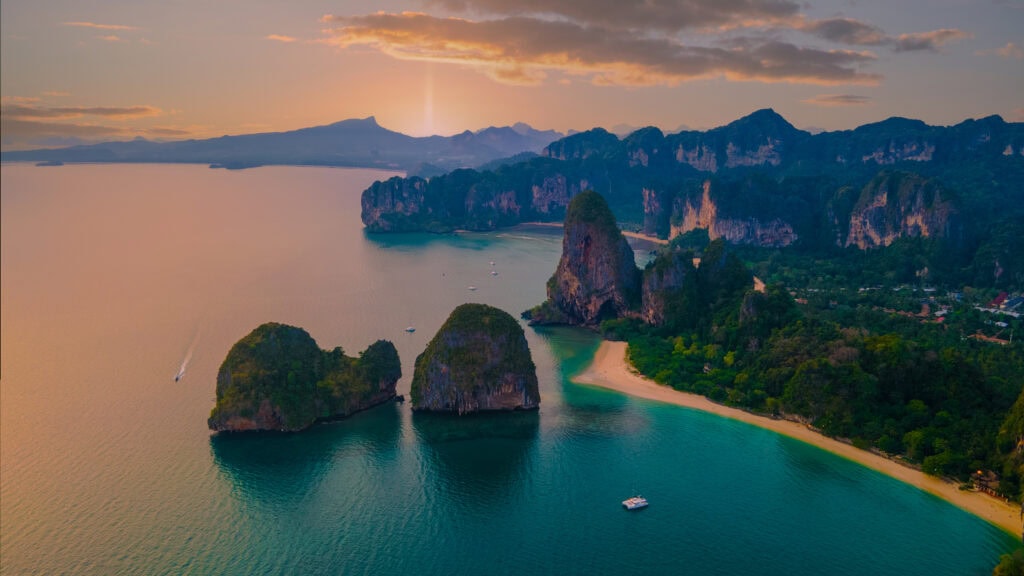
The peninsula is where Krabi’s scenery becomes almost theatrical. Railay West opens onto a broad arc of sand framed by cliffs, with sunsets directly over the Andaman Sea. The beach here is the image many travellers carry of Krabi: longtails bobbing in shallow turquoise water, karst towers rising from the waves, and a feeling that the outside world is comfortably far away.
Railay East, on the opposite side, faces a mangrove-fringed bay. It is less of a swimming beach and more of a launching point for boats, but it has a distinct atmosphere at high tide, with a boardwalk, bars and views of the cliffs changing colour at dusk. Many travellers stay here for slightly quieter surroundings and walk across to Railay West or Phra Nang for swimming.
Phra Nang Beach, reached via a short path from Railay East, is arguably the peninsula’s most memorable strand. It is narrow and can feel busy in the middle of the day when boats arrive from Ao Nang and beyond, but the setting is exceptional: overhanging cliffs, fine sand and a series of small caves, including the well-known Princess Cave with its local offerings. Early mornings and late afternoons are particularly peaceful, when day trippers have yet to arrive or are already heading back.
As a base, Railay works well for travellers who want classic beach days without the need to travel far. You can walk everywhere within the peninsula, swim at Railay West or Phra Nang, and then slip back to your room in minutes. It is especially appealing if your idea of the best place to stay in Krabi includes beach access, limited traffic and dramatic scenery as a constant backdrop.
The trade-off comes with logistics. Every arrival and departure involves a boat, and transfers can be mildly weather- or tide-dependent. Evening options are more limited than in Ao Nang, with a small cluster of restaurants and low-key bars. For some, this concentrated, walkable setting is precisely the point; for others, it can feel restrictive after several days.
Tonsai: Laid-Back Enclave Between Cliffs and Sea
Tonsai lies just north of Railay, separated by headlands and cliffs. It has long been associated with rock climbers and travellers who prefer a more low-key, bohemian feel. Access is again by longtail boat, usually from Ao Nang or from Railay at high tide, and at low tide it is sometimes possible to walk between Tonsai and Railay West along the shoreline or via simple jungle tracks.
Compared with Ao Nang and Railay, Tonsai is noticeably quieter. The bay is wide, bookended by sheer limestone faces, and the sand is backed by a line of simple bars, small guesthouses, and climbing schools. At low tide the bay empties dramatically, revealing rocky flats and making swimming less convenient. High tide brings softer water access, but compared with Railay West and Phra Nang, the beach experience is more rugged.
For travellers, this is either a charm or a compromise. If your priority is a relaxed base with a sense of community and you do not mind that the beach is not perfect for swimming at all times, Tonsai can be a rewarding choice. Days often revolve around climbing routes, slacklines in the shade, and slow afternoons in hammocks rather than structured excursions.
In the broader comparison of Ao Nang vs Railay vs Tonsai, Tonsai sits firmly at the most laid-back end of the spectrum. It suits travellers who are comfortable with limited infrastructure and who appreciate a slightly off-grid atmosphere close to nature. Evenings are low-key, with a handful of bars and simple eateries rather than a wide restaurant choice.
Logistically, you will still need to factor in boat transfers for arrival, departure and excursions, though the distances are short. If you foresee frequent trips to neighbouring islands or prefer to mix climbing with comfortable beach days, some travellers choose to stay in Railay West and visit Tonsai during the day, but as a base, Tonsai is distinct enough to justify consideration in its own right.
Ao Nang vs Railay vs Tonsai: Which Krabi Base Matches Your Style?
Looking at Krabi hotel areas purely on a map can be misleading. Distances appear minimal, yet the cliffs and sea routes mean each area feels self-contained, with its own rhythm and level of convenience. Thinking of them as three different bases rather than interchangeable beaches helps clarify which one matches your style of travel.
Convenience and variety: Ao Nang – Ao Nang is the most practical choice if you prefer road access, quick transfers and a range of everyday services. It works especially well for shorter trips or for travellers arriving from Europe who want to minimise extra steps after a long journey.
Scenery and beach time: Railay – Railay offers the most balanced combination of soft sand, dramatic scenery and walkable scale. It feels like a small coastal village without cars, where your days can easily revolve around beach time, short walks and occasional boat trips.
Quiet and character: Tonsai – Tonsai is the choice for a slower tempo and a more alternative feel, particularly if climbing or spending time with nature is central to your stay, and you are comfortable without highly polished infrastructure.
From a European perspective, where long-haul time is finite, it can help to ask whether you want your Krabi base to function more as a comfortable hub (Ao Nang) or as a self-contained beach escape (Railay or Tonsai). Many travellers combine two of the three for contrast, but each can easily fill three to five days without feeling repetitive.
Beach Days and Activities in Each Area
Beyond accommodation, the experience of a beach day in each area is subtly different. Understanding tides, boat patterns and access helps align expectations, particularly if you are aiming for gentle, unhurried days after a long journey from Europe.
In Ao Nang, mornings are well suited to beach walks along the main bay or towards Noppharat Thara, just to the west, which is quieter and backed by casuarina trees. Swimming is possible but the atmosphere is more active, with longtail engines starting early for island trips. Many visitors use Ao Nang primarily as a launch point for days spent on Hong Island, the Four Islands, or even Koh Phi Phi, returning tired and sun-drowsy in the late afternoon.
Railay’s beach rhythm is more contained. A typical day might start with a swim off Railay West before the bulk of day boats arrive, followed by a stroll to Phra Nang for mid-morning sun and perhaps a shaded lunch under the cliffs. By early afternoon, when the light turns softer, the peninsula naturally slows, with guests drifting back to pools, verandas and shaded bars. Evening walks along Railay West become a daily ritual, with the sea turning coppery before dark.
In Tonsai, beach days are often punctuated by the tide. At low tide, the focus shifts from swimming to exploring tide pools, walking over to Railay, or climbing. As the water returns, the bay becomes more inviting for a cooling dip, often combined with sunset views from the western end of the beach. The lack of heavy development keeps evenings quiet, with the sound of the sea and occasional music from small bars rather than a full promenade atmosphere.
Across all three areas, longtail boats create a constant backdrop of movement and sound. For most travellers this becomes part of the Andaman experience, but if you value hushed, almost silent beaches above all else, timing your swims for early morning and later afternoon is a simple way to reclaim tranquillity.
Getting Around: Boats, Roads and Transfers
Transport is a key element in deciding where to stay in Krabi, especially when comparing Ao Nang vs Railay vs Tonsai from a European traveller’s perspective. After a long journey, the number of steps between airport and room can be decisive.
Ao Nang offers the most direct route. From Krabi International Airport, it is an uncomplicated drive of under an hour. Taxis and shared transfers are straightforward, and once there you can move by tuk-tuk, songthaew or on foot along the beach road.
Railay and Tonsai add a layer of boat logistics. From the airport you first reach Ao Nang or Ao Nam Mao pier by road, then transfer to a longtail boat for the final approach. Boats operate frequently in daylight during high season, but schedules can thin out in shoulder periods or during rougher weather. Evenings are calmer; reaching or leaving Railay late at night may require arranging a boat in advance or paying extra for a private transfer.
Between Ao Nang and Railay, standard longtail boats run as a shared service when enough passengers gather, with the journey taking around 10–15 minutes. From Railay to Tonsai, the journey is even shorter, though sometimes travellers prefer to walk at low tide rather than wait for a boat. For inter-island excursions, most operators will collect guests directly from the main beach of each area, subject to sea conditions.
While these extra steps can seem complex at the planning stage, in practice they become part of the daily rhythm. The key is to allow generous time cushions around flights or onward ferries, particularly if you are staying on Railay or Tonsai.
Practical Travel Tips for Krabi Beach Bases
- Allow extra time between your flight and any boat transfers to Railay or Tonsai, especially in the late afternoon when seas can be choppier or services less frequent.
- Pack a small waterproof bag or dry sack for valuables; boarding longtail boats often involves stepping into shallow water rather than onto a pier.
- Bring light footwear that can get wet, such as sandals with a back strap; you may wade through water when arriving or leaving beaches in all three areas.
- For Railay and Tonsai, use luggage with durable wheels or opt for a backpack. Paths are sandy and uneven, and porters are not always available.
- Check tide times locally if you plan to walk between Railay and Tonsai; routes that are simple at low tide may be inaccessible at high tide.
- In Ao Nang, traffic builds up along the main road in the evening. Walking the seafront promenade is often quicker than short tuk-tuk rides at peak times.
- Respect local norms by wearing a cover-up when walking through villages or using boats, saving swimwear-only outfits for the beach itself.
- Sun intensity is strong, especially around midday. European visitors often appreciate planning beach time for early morning and late afternoon, using the middle of the day for shaded cafés or indoor rest.
- During the wetter months, afternoon showers are common. A light foldable rain jacket or compact umbrella is useful, particularly when moving between boat, beach and room.
- Noise levels vary: Ao Nang’s central strip is livelier at night, while Railay and Tonsai are generally quieter but can have pockets of music. Check how close your chosen spot is to bars if you are sensitive to sound.
FAQs About Where to Stay in Krabi
Is Ao Nang or Railay better for a first visit to Krabi?
Ao Nang is better if you value straightforward transport, a wide choice of dining options and easy access to the mainland. Railay is better if your priority is scenic beaches and a car-free setting, and you do not mind relying on boats for all arrivals and departures.
Is Railay more expensive than Ao Nang as a base?
Railay can feel more expensive overall because of its smaller scale and boat-only access. Ao Nang has a broader range of accommodation and dining, which can offer more variety across different comfort levels, but both areas include simple and more refined options.
Is Tonsai suitable if I am not a climber?
Tonsai is still enjoyable if you are not a climber, provided you appreciate a relaxed, informal atmosphere and do not expect perfectly groomed beaches or extensive facilities. The area is more about slowing down than structured sightseeing.
How easy is it to move between Ao Nang, Railay and Tonsai during a stay?
During daytime in the dry season, it is relatively easy: shared longtail boats link Ao Nang and Railay frequently, and short hops or walks connect Railay and Tonsai. After dark or in rough weather, movement can require more planning and flexibility, so it is best not to rely on late-night transfers.
What is the best place to stay in Krabi for island-hopping?
Ao Nang offers the most convenient base for frequent island-hopping thanks to its road access, numerous operators and flexible boat departures. Railay also works well, with trips departing directly from the beach, while Tonsai is more suitable if you prefer occasional excursions rather than daily outings.
Conclusion: Matching Krabi’s Coasts to Your Beach Days
Ao Nang, Railay and Tonsai offer distinctly different versions of a Krabi stay, shaped by their geography and access. Ao Nang functions as a practical mainland hub with easy transfers and everyday convenience. Railay provides classic beach scenery in a walkable, car-free peninsula where cliffs and sand define daily life. Tonsai, set slightly apart, offers a quieter, more informal enclave, especially appealing to climbers and travellers drawn to a slower pace.
For European travellers looking to recover from long flights and settle into beach days, understanding these contrasts helps align expectations with reality. Each area can host a rewarding stay; the right choice depends on whether you value convenience, scenery or seclusion most in your time by the Andaman Sea.
Recommended next:
- Thailand Itinerary 10 Days: Bangkok, Chiang Mai & Islands for First-Timers
- Thailand Itinerary 14 Days: Classic Route with Beaches and Northern Culture
- Thailand in 7 Days: Bangkok + One Beach Base (No Rushing)
- Best Time to Visit Thailand: Month-by-Month Weather for Europeans
- Thailand Travel Costs: Realistic Daily Budget for European Travelers
- Thailand Travel Insurance Guide: What to Cover and What to Skip
- More in Thailand →