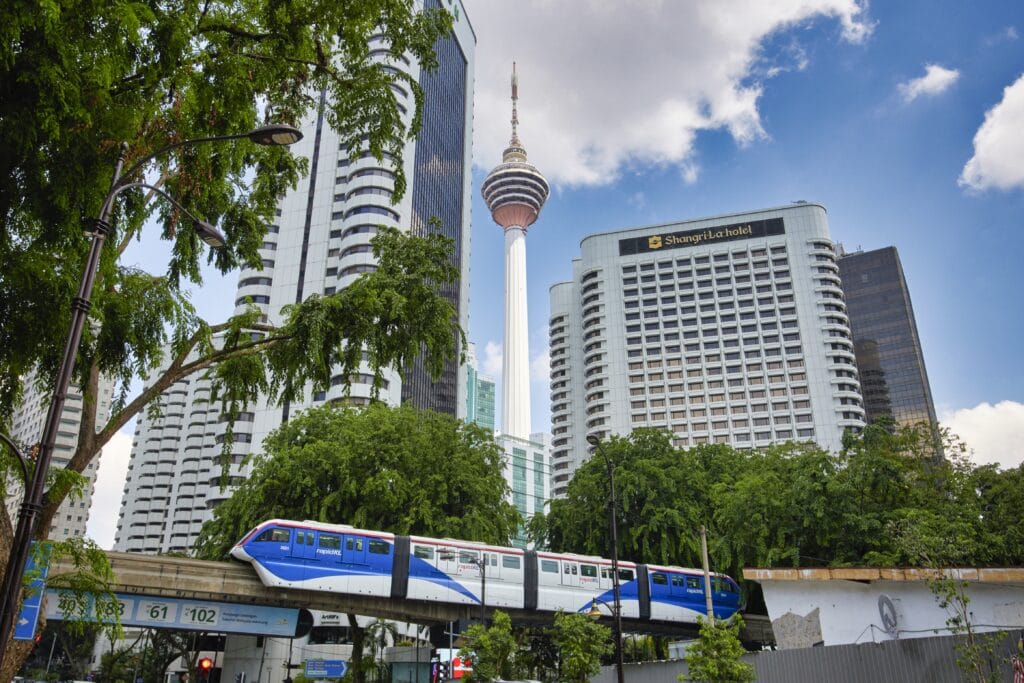
Kuala Lumpur has an extensive mix of MRT, LRT, monorail, commuter rail and bus services. The network is useful for sightseeing, but it is operated through several systems, and station names do not always correspond neatly with the places visitors want to reach.
This Kuala Lumpur public transport guide explains the main rail lines, ticket options, useful interchanges and when booking Grab is the more convenient choice.
Quick answer
Use the MRT and LRT for most journeys between central districts, shopping areas and major attractions. The KL Monorail is helpful around Bukit Bintang and parts of the city centre, while KTM Komuter serves selected suburban routes. Grab is often more practical for door-to-door trips, late arrivals, heavy luggage or destinations far from a station.
For a short visit, plan each journey using the station nearest your actual destination rather than relying only on neighbourhood names. Do not assume that a European contactless bank card will work at every gate; check the current payment options and buy an accepted ticket or stored-value card where necessary.
Kuala Lumpur transport at a glance
| Transport option | Best for | Main limitation |
|---|---|---|
| MRT | Cross-city journeys, Bukit Bintang, TRX and destinations along the Kajang and Putrajaya corridors | Some attractions still require a walk or short onward ride |
| LRT | Central interchanges, established urban corridors and connections around the wider city | The different branches and interchange points can initially be confusing |
| KL Monorail | Bukit Bintang, shopping districts and selected central stops | Limited geographical coverage |
| KTM Komuter | Selected suburban destinations and places outside the core rapid-transit network | Services may be less frequent than urban MRT or LRT trains |
| Bus | Short local links and areas away from rail stations | Road congestion can make journey times less predictable |
| Grab | Door-to-door travel, groups, luggage and awkward station connections | Road traffic, pickup restrictions and changing demand can affect the journey |
KL MRT guide
Kuala Lumpur’s MRT network has two principal lines: the Kajang Line and the Putrajaya Line. On maps and station signs, follow the line name, direction of travel and final station rather than relying on colour alone. Colours can appear differently across apps, printed maps and older travel guides.
Kajang Line
The Kajang Line is particularly useful for visitors because it serves central locations including Pasar Seni, Bukit Bintang and Tun Razak Exchange, commonly abbreviated to TRX. It continues northwest and southeast into districts beyond the main tourist centre.
Pasar Seni is convenient for Chinatown, Central Market and connections with the Kelana Jaya LRT Line. Bukit Bintang serves the major shopping and entertainment district. TRX is an interchange with the Putrajaya Line.
Muzium Negara MRT station is connected with the wider KL Sentral area by a pedestrian link. Allow extra time for this transfer because changing between the station and the main KL Sentral complex involves walking rather than simply crossing a platform.
Putrajaya Line
The Putrajaya Line crosses the city through areas including TRX and continues toward Putrajaya. It can be useful for travellers staying near stations on its northern or southern sections, as well as for journeys that connect with the Kajang Line at TRX.
Putrajaya is outside central Kuala Lumpur, so confirm which station is closest to your destination and whether an onward bus or car journey is needed. A station name that includes a district does not necessarily mean every attraction in that district is within a short walk.
KL LRT lines explained
The principal KL LRT lines visitors encounter are the Kelana Jaya Line, Ampang Line and Sri Petaling Line. The Ampang and Sri Petaling services share part of their route before separating, so check the train’s destination rather than boarding solely on the basis of the platform or line colour.
Kelana Jaya Line
The Kelana Jaya Line is one of the most useful routes for visitors. It serves KL Sentral and central interchange stations such as Pasar Seni and Masjid Jamek, then continues through residential and commercial districts on either side of the centre.
Masjid Jamek is useful for changing between LRT routes and for reaching the historic centre. Pasar Seni provides an interchange with the MRT Kajang Line. At KL Sentral, follow the signs carefully because the transport complex includes several different rail services.
Ampang and Sri Petaling lines
These lines cover parts of central and suburban Kuala Lumpur. Their shared central section can be convenient, but the route branches farther out. Before boarding, compare the destination shown on the train or platform display with the branch you need.
If a journey planner suggests changing lines, check the interchange name and walking route. Some transfers are within a connected station complex, while others may involve a longer walk than the map implies.
When to use the KL Monorail
The KL Monorail is a compact elevated line serving several central districts. It is especially relevant around Bukit Bintang and can connect travellers with the KL Sentral area and other transport routes.
It is useful when both your starting point and destination are near its stations. For longer cross-city journeys, the MRT or LRT may offer a more direct route. During busy periods, travellers carrying large suitcases may find a car more comfortable than navigating platforms and crowded vehicles.
How tickets and payment work
Ticket products and accepted payment methods can change, so check the current information displayed at the station. MRT and LRT stations commonly provide single-journey ticket facilities, while stored-value transport cards are widely used for repeated travel.
Single-journey tickets
A single-journey ticket or token is suitable if you expect to make only a few rail trips. Select the correct destination at the machine or counter and retain any token or ticket issued until you have passed through the exit gate.
Machines may not accept every note, coin or foreign-issued payment card. Carrying some Malaysian currency is sensible, particularly just after arrival.
Stored-value cards
A stored-value card can reduce the need to buy a separate ticket for each journey. Touch ‘n Go is commonly used across parts of the transport network, but accepted services, purchase locations, refund conditions and minimum balance requirements can change. Confirm the current rules before loading more credit than you expect to use.
Passes
Visitor or unlimited-travel passes may be offered, but their value depends on the services included and how many journeys you will make. Compare the current pass conditions with your itinerary rather than assuming a pass is automatically cheaper.
Contactless bank-card use is not necessarily as universal as it is on some European city networks. Do not rely exclusively on tapping a Visa or Mastercard at the gate without checking that the specific service accepts it.
Useful stations and interchanges
- KL Sentral: the city’s principal transport hub, with access to several urban, commuter and airport-related rail services. Transfers can involve walking through a large complex.
- Pasar Seni: an MRT and LRT interchange convenient for Chinatown and Central Market.
- Masjid Jamek: a useful LRT interchange near the historic core.
- Bukit Bintang: served by MRT and monorail stations in the main shopping and entertainment area. Check which entrance is closest to your destination.
- TRX: the interchange between the two MRT lines.
- Muzium Negara: linked on foot with the KL Sentral area, although the transfer requires more walking than a same-platform connection.
Using Grab in Kuala Lumpur
Grab in Kuala Lumpur is useful for destinations far from rail stations, trips with luggage and journeys where several people can share one vehicle. You generally enter the destination in the app and review the displayed vehicle and fare information before confirming.
Choose a precise pickup point
Large shopping centres, hotels and stations can have several entrances or designated ride-hailing zones. Use the pin carefully, read any pickup instructions and check the level or entrance name. Sending the driver a short message with a visible landmark can help when a complex has multiple access roads.
Allow for traffic
Central Kuala Lumpur can experience substantial road congestion. A short distance on the map may take longer by car than by train, especially during commuting periods or heavy rain. For a fixed appointment, compare the road route with the nearest MRT or LRT option.
Check the complete trip details
Review the vehicle category, passenger capacity, pickup location and any information about tolls or additional charges before confirming. Conditions may differ for airport journeys and larger vehicles. If travelling with several full-size suitcases, choose a vehicle category that can realistically accommodate them.
Keep mobile data available
You need a working data connection to monitor the booking and communicate with the driver. Arrange roaming, an eSIM or a local SIM before depending on the app. It is also useful to keep the hotel’s address saved offline in case your connection drops.
Airport transport and the city network
Kuala Lumpur’s airport rail and road transfers should be planned separately from ordinary MRT and LRT journeys. Depending on your destination, you may be able to connect through KL Sentral or use a road transfer directly to your accommodation.
Check which terminal you are using, the current airport train or bus arrangements, and the operating period before travel. For a late arrival, a group or bulky luggage, a pre-arranged transfer or app-based car may be easier, but road traffic should be considered.
Who each option suits
Best for first-time visitors
Combine MRT and LRT journeys with occasional Grab rides. Rail works well for major sightseeing areas, while Grab can cover the final distance to hotels or attractions away from stations.
Best for budget-conscious travellers
Base most journeys around the rail network and use buses where the route is straightforward. Check whether single tickets, stored value or a current travel pass best fits the number of trips planned.
Best for families and small groups
Compare the combined cost and effort of several rail tickets with one appropriately sized Grab vehicle. Rail may still be quicker when roads are congested, but a car can simplify trips involving young children, pushchairs or luggage.
Best for travellers with limited mobility
Many modern stations have step-free facilities, but lifts, entrances and pedestrian connections may not always be positioned conveniently for your destination. Check the specific stations in advance and consider a door-to-door vehicle when long walkways or uneven pavements would be difficult.
Practical tips for European travellers
- Download an up-to-date network map and a journey-planning app before leaving your hotel.
- Search for the exact station entrance or attraction, not just the wider district.
- Do not assume every transport service uses the same ticketing system.
- Carry a small amount of Malaysian currency in case a machine does not accept your card.
- Leave extra time for interchanges at large hubs such as KL Sentral.
- Expect heat, humidity and sudden rain to make a seemingly short walk less comfortable.
- Take a light layer for strongly air-conditioned trains, shopping centres and vehicles.
- Keep bags close and follow the same normal precautions you would use on busy public transport in a European capital.
- Check current service notices before important journeys, particularly early in the morning or late at night.
For a broader overview of intercity rail, buses and flights beyond the capital, read Getting Around Malaysia: Trains, Buses and Domestic Flights Explained.
Common mistakes to avoid
- Confusing KL Sentral with every nearby station: connected services may have different station names and require a walk through the complex.
- Boarding the wrong LRT branch: check the train’s final destination on routes that divide.
- Underestimating station exits: choosing the wrong exit can add a long outdoor walk.
- Using Grab for every central trip: rail can be more predictable when roads are congested.
- Assuming a bank card will open every gate: verify payment acceptance before joining the queue.
- Leaving no time for the final kilometre: some attractions and hotels are not immediately beside the station carrying the district’s name.
FAQ
Is Kuala Lumpur public transport easy for tourists?
It is manageable once you understand the main MRT and LRT corridors. Signs and journey-planning apps help, but allow additional time for large interchanges, station exits and walking connections.
Which train line is best for Bukit Bintang?
The MRT Kajang Line serves Bukit Bintang, and the KL Monorail also has a station in the district. Choose according to your starting point and the entrance closest to your hotel, shopping centre or restaurant.
Can I pay for Kuala Lumpur trains with a European bank card?
Do not assume that foreign contactless cards are accepted directly at every gate or ticket machine. Payment arrangements vary by service and can change. Check the station information and keep an alternative payment method available.
Is Grab better than the MRT or LRT in Kuala Lumpur?
Neither is always better. MRT and LRT services avoid road congestion and work well along their main corridors. Grab is often more convenient for luggage, groups, late arrivals and destinations that require a long walk from the nearest station.
Final recommendation
Use the MRT and LRT as the backbone of your Kuala Lumpur itinerary, adding the monorail for selected central trips and Grab for awkward connections or luggage-heavy journeys. Check current routes, fares and payment rules before travelling, and leave extra time for large stations and road traffic.