Introduction
This guide is written for European travellers researching where to stay in Marina Bay Singapore. It addresses practical concerns — orientation, walkability, the different character areas around the waterfront, and what to expect from the skyline and local rhythms — so you can plan an informed, comfortable stay without marketing or sales language.
Area overview and layout
Marina Bay is a compact, carefully planned stretch of central Singapore that sits at the edge of the Central Business District (CBD). The waterfront forms a near-circular basin with promenades, civic buildings and green spaces that frame views across the water. To the north are the older office towers and the historic civic precinct; to the south and east are newer developments, gardens and cultural venues. Key navigation points are the main MRT stations around the bay and a continuous promenade that links major sights in a roughly two- to three-kilometre loop.
Where different types of travellers usually stay
Different parts of Marina Bay naturally appeal to different travellers. Business travellers often choose accommodation close to the financial core and MRT connections for early meetings and efficient commutes. Leisure travellers seeking skyline views and easy access to the waterfront attractions tend to favour properties on the bayfront itself; these provide direct access to the promenade and evening vistas. Couples and city travellers who prioritize atmosphere and architecture often look for rooms facing the harbour or nearby rooftop terraces. Families and those planning longer stays sometimes opt for serviced apartments or quieter blocks set slightly away from the busiest stretch of the promenade.
Skyline views and where to find them
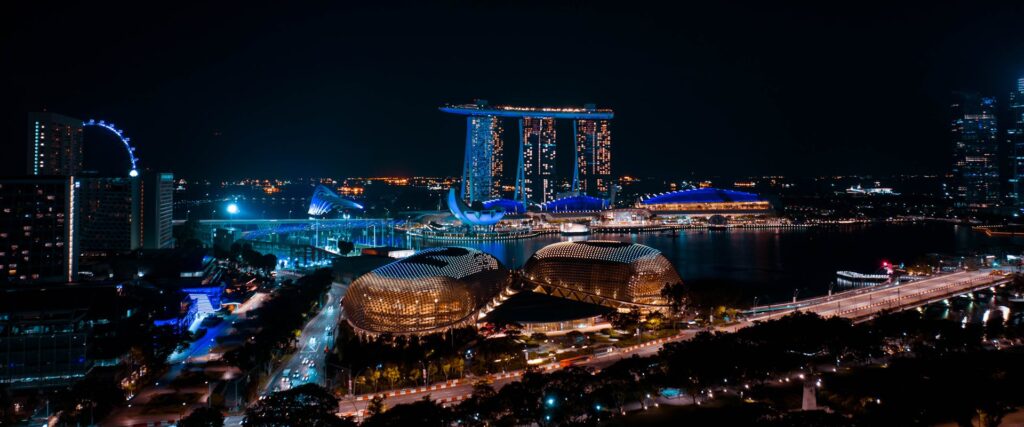
The defining image of Marina Bay is its sculpted skyline: modern towers, illuminated façades and reflections on the water after dusk. If skyline vistas matter, seek accommodation with a harbour-facing orientation rather than an inward courtyard. Rooms on higher floors offer the clearest perspectives, but the bay’s public spaces also provide memorable views — a twilight walk along the promenade, the terraces at civic venues and the elevated parklands offer panoramic frames for photography and quiet contemplation. Consider how you plan to use those views: morning light, sunset tones and the post-sunset glow each present the skyline differently.
Transport, walkability and connections
Marina Bay is walkable by central-city standards. The promenade is continuous and largely pedestrian-friendly, with sheltered sections and crossings that prioritise safety. Three MRT interchanges sit around the bay, providing rapid links to the airport, museum district and residential quarters; buses and river taxis supplement those options for shorter hops. Walking between key landmarks typically takes 10–25 minutes, depending on pace and detours. For travellers arriving from Europe, public transport in Singapore is efficient and predictable; luggage-friendly routes and sheltered walkways make transfers in humid weather manageable.
What defines the local experience in Marina Bay
Marina Bay combines urban precision with generous public space. The local experience is as much about the waterfront promenades and evening light as it is about the formal architecture of the civic buildings. Daytime brings a steady stream of office workers and tourists; evenings open up to leisurely strolls, waterfront dining and programmed lighting that accentuates the skyline. Cultural events and seasonal installations occasionally animate the public spaces, while quieter pockets of green and waterfront seating provide respite from the city’s constant motion. The atmosphere is orderly, calm and cosmopolitan.
Planning considerations for European travellers
When arranging travel from Europe, account for climate, time shift and daily rhythm. Singapore’s equatorial humidity affects how you pack: lightweight, breathable fabrics and comfortable walking shoes are essential. Public transport accepts contactless payments familiar to European visitors, but it is sensible to check card compatibility ahead of travel. Consider how jet lag will affect your first evenings — the bay’s nightlife is relaxed after dark, but early mornings are often the most pleasant for walking and photography. If you value quiet, choose accommodation slightly back from the busiest promenade rather than directly on it.
Practical travel tips
- Use the main MRT stations around the bay for quick orientation: they provide the most reliable links to the airport, museums and the wider city.
- Plan walks in the early morning or after sunset to avoid the midday humidity and to catch the best light for skyline views.
- Choose harbour-facing rooms on higher floors if uninterrupted skyline views are a priority; ground-floor access is useful for families and those with luggage.
- Carry a light, foldable umbrella or a compact rain jacket — tropical showers can be sudden but brief.
- Allow time for moving between venues: crossings and pedestrian routes are efficient but sometimes involve detours around civic plazas.
- Respect local norms: quiet voices in public spaces, orderly queues and a general preference for clean, considerate conduct.
- For quieter evenings, consider accommodation one block back from the promenade where street noise and foot traffic are reduced.
FAQs
Is Marina Bay a good area to stay in for first-time visitors to Singapore?
Yes. Marina Bay provides a compact orientation to the city with easy access to major sights, clear transport options and a continuous waterfront that helps first-time visitors quickly understand Singapore’s layout and scale.
How walkable is Marina Bay for someone who prefers to explore on foot?
Highly walkable. The promenade links most attractions and the distances between sites are short by city standards. Sheltered walkways and crossings make walking comfortable, though daytime humidity can be tiring.
Where are the best vantage points for skyline photography?
High-floor rooms facing the harbour, elevated parklands and the continuous promenade after sunset provide the clearest, most photographic views. Morning and evening light produce distinct moods for images.
Is public transport convenient for reaching other parts of Singapore from Marina Bay?
Yes. Several MRT interchanges and bus routes serve the bay, offering straightforward connections to cultural districts, shopping areas and transit hubs across the island.
Are there quieter places to stay near Marina Bay if I prefer less noise?
Yes. Choosing accommodation one block inland from the main promenade or in adjacent streets reduces foot traffic and evening sound while keeping the waterfront within easy walking distance.
Conclusion
Marina Bay offers a clear, navigable base for exploring central Singapore: a combination of striking skyline views, pedestrian-friendly promenades and efficient transport links. For European travellers seeking orientation, comfort and the characteristic waterfront atmosphere, understanding the neighbourhood layout and planning for climate and rhythm will make a stay both pleasant and well adapted to your travel priorities.