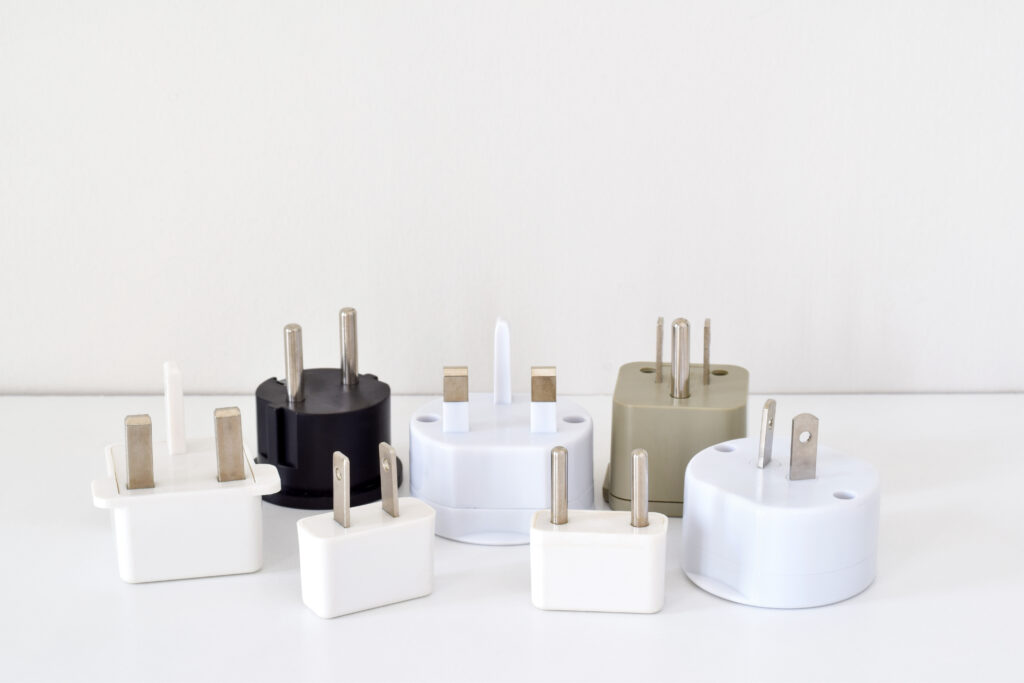
Singapore uses Type G power sockets, so most visitors from continental Europe need a plug adapter. Voltage is less likely to be a problem because Singapore’s 230V, 50Hz supply is compatible with many European devices, but you should always check the label on each charger or appliance.
Quick answer
Travelers with Type C, E, F, J, K or L plugs will generally need a Singapore plug adapter that converts their plug shape to Type G. Devices with a British-style Type G plug normally fit without an adapter.
Singapore operates on 230V at 50Hz. Most European phone chargers, laptop chargers and other modern electronics support this supply. A plug adapter changes only the plug shape; it does not convert voltage.
| What to check | Singapore standard | What European travelers may need |
|---|---|---|
| Socket type | Type G | A Type G adapter unless the device already has a Type G plug |
| Voltage | 230V | Usually compatible with European devices marked for 220–240V or 100–240V |
| Frequency | 50Hz | Normally compatible with European electronics marked for 50Hz or 50/60Hz |
| Voltage conversion | Not provided by a basic adapter | Only relevant if the appliance is not rated for Singapore’s supply |
What is the Singapore power socket?
The standard Singapore power socket is Type G. It has three rectangular openings in a triangular arrangement and is the same basic plug format used in the United Kingdom and Ireland.
Two-pin continental European plugs do not directly match a Type G socket. Do not force a round-pin plug into the socket or try to defeat its shutters with another object. Use a correctly designed adapter instead.
Which European plugs need an adapter in Singapore?
Most continental European travelers need an adapter. This includes people bringing common Type C Europlugs and the Type E or F plugs used by many larger or earthed appliances.
Italian Type L, Swiss Type J and Danish Type K plugs also generally require an appropriate Type G adapter. If your device already has a Type G plug, no plug-shape conversion is normally necessary.
| Plug brought from Europe | Adapter normally needed? | Important consideration |
|---|---|---|
| Type C Europlug | Yes | Choose an adapter that securely accepts the two round pins |
| Type E or F | Yes | For earthed equipment, use an adapter that maintains the earth connection |
| Type J, K or L | Yes | Confirm that the adapter specifically accepts your plug type |
| Type G | Usually no | Check the device voltage label and condition of the plug |
Singapore voltage and European devices
The Singapore voltage is 230V, with a frequency of 50Hz. This is close to or the same as the standard used across much of Europe, so many European devices work without a voltage converter.
Before connecting anything, find the input information printed on the charger, power supply or appliance. It may be on the plug body, charging brick, underside of the device or near the power cable.
- If the label says “Input 100–240V, 50/60Hz,” the device is designed for Singapore’s supply and normally needs only the correct plug adapter.
- If it says “220–240V, 50Hz,” it should also be compatible with Singapore’s electricity supply.
- If it is marked only for 110–120V, do not connect it using a basic adapter. Check whether a suitable voltage converter is available and appropriate for that appliance.
- If the voltage information is missing or unclear, consult the manufacturer before travel.
Adapter or voltage converter?
A Singapore plug adapter changes the physical connection from a European plug to a Type G plug. It does not alter the electricity reaching the device.
A voltage converter changes voltage and is only needed for equipment that cannot accept 230V. Converters must also be suitable for the appliance’s power demand, which can be substantial for heating devices. In many cases, leaving an incompatible appliance at home is simpler than relying on a travel converter.
Which Singapore plug adapter is best for your trip?
Best for most continental European travelers
A dedicated European-to-Type G adapter is the simplest choice if Singapore is your only destination. Select one that explicitly accepts your home plug type rather than assuming every adapter accepts all European plugs.
Best for a multi-country itinerary
A universal travel adapter can be practical when visiting destinations with different socket systems. Check that it includes a Type G output, securely accepts your device’s plug and is rated for the equipment you plan to connect.
Best for several USB devices
A Type G USB or USB-C charger with several ports can reduce the number of separate adapters needed. Confirm that its output specifications match your phone, tablet, watch or laptop. USB port shape alone does not guarantee suitable charging performance.
Best for earthed or high-power appliances
Use extra care with equipment that has an earthed Type E or F plug, or that draws significant power. The adapter should preserve the earth connection where required and must be rated for the appliance. A small unearthed travel adapter is not automatically suitable for every device.
Practical tips for European travelers
- Pack at least one Type G adapter in your hand luggage so you can charge essential devices after arrival.
- Check every appliance separately. A compatible laptop charger does not mean a hairdryer or electric shaver has the same voltage range.
- Look at the maximum electrical rating printed on the adapter and do not exceed it.
- Avoid connecting several high-power appliances through one adapter or continental extension strip.
- For dual-voltage appliances with a manual switch, set the appliance to the 220–240V position before plugging it in.
- Replace adapters that feel loose, have exposed parts, show heat damage or do not hold the plug securely.
- If buying an adapter before departure, choose a well-made product from a reputable retailer and follow its instructions.
Hairdryers, straighteners and other heat appliances
Hairdryers, straighteners, curling irons and travel kettles need more attention than phone chargers because they can draw considerably more power. Check both the voltage range and the appliance’s wattage against the adapter or converter rating.
A dual-voltage hair appliance may work if it is correctly switched to the higher-voltage setting. A model designed only for 110–120V should not be used on Singapore’s 230V supply with a plug adapter alone.
If your accommodation provides the appliance you need, using the locally supplied item can be more straightforward than traveling with high-power equipment. Check directly with the property because room facilities vary.
FAQ
Do European plugs work in Singapore?
Most continental European plugs do not fit a Singapore power socket directly because Singapore uses Type G. Type C, E, F, J, K and L plugs generally need an adapter. A device already fitted with a Type G plug will normally fit.
Do I need a voltage converter for Singapore?
Usually not for European devices marked 220–240V, 50Hz or 100–240V, 50/60Hz. You may need a suitable converter for an appliance marked only for 110–120V. Check the device label rather than relying on its country of purchase.
Can I charge my phone or laptop in Singapore?
Most modern phone and laptop chargers accept 100–240V and 50/60Hz, but confirm this on the charging brick. If compatible, you only need a Type G adapter or a suitable Type G USB charger.
Can I use a European hairdryer in Singapore?
A European hairdryer rated for 220–240V and 50Hz may be electrically compatible, but its power demand must also be within the adapter’s rating. Hairdryers designed only for 110–120V require more than a simple plug adapter and are often better left at home.
Final recommendation
For most travelers from continental Europe, pack a reliable European-to-Type G Singapore plug adapter. Check each device for 230V compatibility, use an earthed and appropriately rated adapter when necessary, and do not assume that a plug adapter also converts voltage.
Last checked: 7 October 2026. Electrical standards and individual product requirements can change, so verify unusual or high-power equipment before travel.