Where to Stay in Pai Thailand: A Mountain Base for European Travellers
This guide to where to stay in Pai Thailand is written for European travellers who value views, atmosphere and walkable access to cafés and night market evenings more than nightlife or resort-style distractions. Pai is small, yet the choice of area shapes how you experience its surrounding mountains, rivers and misty mornings.
For many visitors coming up from Bangkok or Chiang Mai, Pai becomes a slower, more intimate counterpart to the capital’s intensity; if you are planning your wider Thailand itinerary, comparing Pai’s scale and feel with an overview of Bangkok’s main neighbourhoods can help you understand how this mountain town fits into the journey. In Pai, staying just a few hundred metres in one direction or another shifts the balance between views, tranquillity and easy strolls to the night market.
Geographically, Pai sits in a highland valley in northern Thailand’s Mae Hong Son province, surrounded by low, forested ridges and rice fields, with the compact town centre clustered along the Pai River.
Understanding Pai’s Layout: River, Rim and Hills
Although Pai is often described as a single village, it naturally divides into a few distinct areas, each offering a different kind of mountain base. Knowing this simple layout is the first step to choosing the Pai best area to stay for your style of trip.
Pai town centre and night market strip – A compact grid of streets north of the river, centred on the main walking street where the night market appears every evening.
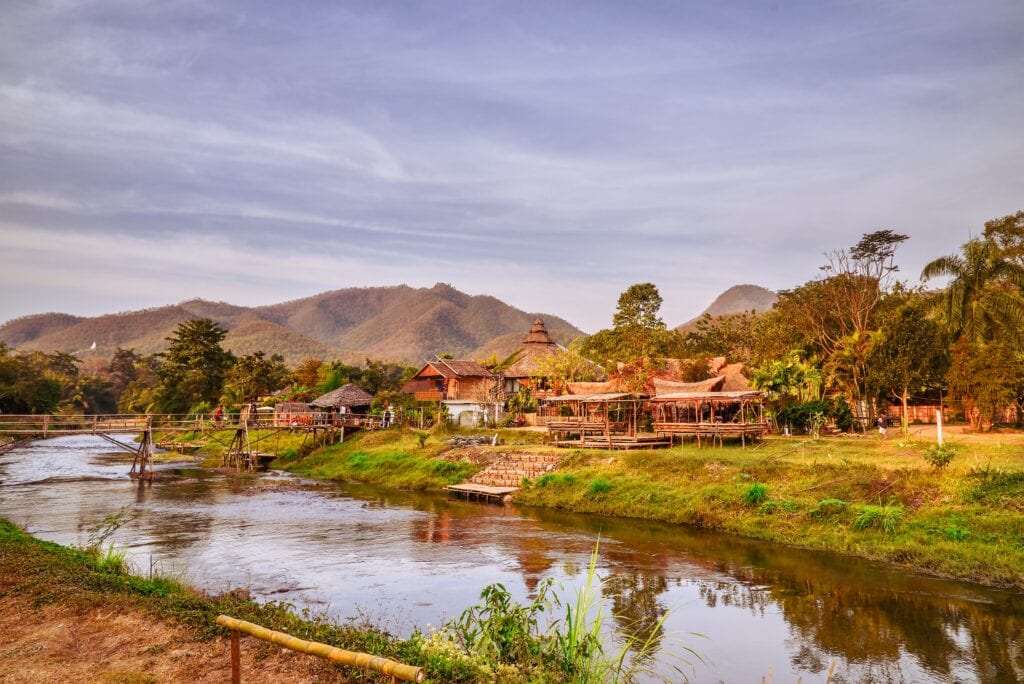
Riverside and bamboo bridge side – Low-rise bungalows and small hotels scattered along the Pai River, with open views to fields and hills.
Western hillside and sunset viewpoints – Slightly elevated lanes to the west, where properties sit on gentle slopes with wider panoramas.
Southern fields and countryside – Quiet pockets beyond the bamboo bridge towards rice paddies and hot springs.
Distances are short: you can usually cross town on foot in 10–15 minutes. The trade-off is between staying steps from the Pai night market location, or retreating into the countryside for more pronounced mountain scenery and silence once the street stalls pack away.
Staying Near the Night Market: Street-Life and Easy Cafés
The streets around Pai’s night market are the obvious choice if you like to wander out in the evening without thinking about transport. The main walking street, which becomes the night market, runs north–south through the centre, with small lanes branching off towards the river and the bus station.
This area suits travellers who want to be in the middle of things while still using Pai as a relaxed mountain base. You can walk to almost everything: cafés spilling onto the pavements, smoothie and noodle stalls, small galleries and massage places, plus the minivan drop-off point if you are arriving from Chiang Mai.
In terms of pai hotels, you will find a mix of simple guesthouses, small design-focused properties and low-rise lodges tucked a few steps away from the busiest stretch. The closer you are to the main street, the more you will hear the evening buzz until around 22:00–23:00, especially at weekends and during high season.
Who this area suits:
First-time visitors who want instant orientation, similar to staying centrally in a European old town.
Solo travellers and pairs who prioritise spontaneous café stops, quick access to vegetarian and international food, and slow night market walks.
Anyone uneasy about navigating country roads at night; everything remains comfortably walkable.
Trade-offs include limited sense of open landscape from your window and a somewhat more transient feel, as this is where minivans arrive and depart.
Riverside Pai: Gentle Views and Short Walks to Town
Crossing the small bridge over the Pai River, you step into a subtly different atmosphere. Riverside lanes still sit close to the Pai night market location – often 5–10 minutes on foot – but feel more open and linked to the valley landscape.
Here, pai hotels and bungalows are typically arranged along the riverbank or set slightly back, with grassy gardens, hammocks and views across to rice fields or forested hills. Morning mist tends to cling to the river, making early starts particularly rewarding for photographers and anyone who enjoys a quiet coffee with a sense of space.
Why choose riverside Pai as a mountain base:
Views are more immediate, with water, fields and hills all within sight, while still allowing you to walk into town for dinner.
The soundscape shifts from scooters and market chatter to birds, frogs and river flow, especially at night.
Paths and small lanes encourage gentle strolls at sunrise or just before dusk, when the hills catch the changing light.
Do note that riverside stays sometimes involve simple wooden bridges or narrow paths, which can feel less structured than European riverside promenades. During the rainy season, humidity is higher, and surfaces can be slippery.
Western Hillside and Sunset Lanes: Wide Valley Panoramas
For travellers who value horizon-wide views over immediate access to shops, the low hillside and back lanes to the west of town offer some of the most appealing vantage points. This is where staying in Pai Thailand begins to feel like staying in a small mountain hamlet rather than a valley town.
Properties in this area often sit slightly above the valley floor, with terraces oriented towards sunsets over the hills. You may find pai hotels and lodges with communal decks, simple gardens and viewpoints where the valley spreads out beneath you, dotted with palms, fields and the meandering river.
Pros of a western hillside base:
Clearer mountain silhouettes at both sunrise (behind the opposite ridges) and sunset.
Less through-traffic and fewer crowds, particularly at night.
A sense of retreat, while still being only a short drive or cycle from the centre.
The trade-off is walkability after dark. While some hillside spots sit close enough to walk into town, many visitors choose to rely on bicycles or scooters, or arrange simple transfers for evening meals. Roads can be narrow and unlit, and during the rainy season they may feel less comfortable for those used to European street lighting standards.
This area suits couples, long-stay visitors and anyone using Pai as a base for day trips to nearby waterfalls and viewpoints, returning each evening to a calm, elevated perspective on the valley.
Southern Fields and Countryside: Immersed in Rural Pai
Beyond the bamboo bridge south of town, small tracks fan out into fields and low hills, dotted with homestays, rustic bungalows and low-key retreats. This is the most rural feel you can have while still being notionally close to the town and night market.
If your priority when deciding where to stay in Pai Thailand is waking up surrounded by fields and tree lines, this part of Pai offers exactly that. Mornings are misty; at certain times of year, rice fields glow green; dogs bark in the distance, and the sounds of the night market feel far away.
Why choose the southern countryside:
A deep sense of quiet and darkness at night, allowing clearer stars when skies are clear.
More space between properties, often giving an impression of staying in someone’s orchard or field.
Convenient access if you plan to visit hot springs, Pai Canyon, or further rural viewpoints during the day.
Reaching the centre usually requires a scooter, bicycle or pre-arranged transport, particularly after dark. Paths across the bamboo bridge can be charming but may feel informal if you are used to more structured infrastructure. This area suits visitors comfortable with a slightly more independent style of travel and those who find restorative value in silence and green surroundings.
Choosing the Right Pai Area for Cafés and Night Market Walks
Across all these areas, cafés are a defining feature of Pai’s appeal. Many European travellers come specifically to slow down, read, or work remotely for a few days while enjoying good coffee and compact, walkable surroundings.
If cafés are central to your plans, staying near the town centre and along the main streets just off the Pai night market location gives you the greatest density of options. You can easily drift between roasteries, minimalist coffee bars and older, bohemian-style cafés that pre-date Pai’s current popularity.
From riverside lodgings, you are rarely more than 10–15 minutes’ walk from these same venues, but your immediate surroundings are greener and quieter. Western hillside and southern countryside stays usually still have one or two cafés or simple eateries within a short ride, yet you will rely more on daytime trips into town to sample the full variety.
Many visitors combine daytime mountain excursions with afternoons spent in town, returning to their countryside or hillside base as light softens. This rhythm allows you to enjoy both the gentle street life around the night market and the sense of retreat and openness that makes Pai a memorable stop in northern Thailand.
How Pai Compares to Other Thai Mountain Bases
For Europeans mapping out a broader Thai itinerary, it can be useful to understand how Pai compares to larger northern hubs such as Chiang Mai. While Chiang Mai offers a broader range of urban neighbourhoods and a strong café culture, Pai condenses everything into a much smaller valley.
In Pai, there is no high-rise skyline and no need for complex transport; your choice is essentially between being in the midst of compact town life or on its tranquil fringes, always under the gaze of surrounding hills. It is this intimacy that makes decisions about where to stay feel important: your pai best area to stay will determine how you experience mist, sound and light more than how you move around the town.
This makes Pai particularly attractive as a final mountain base at the end of a longer journey through Thailand, offering a slower tempo and a feeling of being cradled by the landscape rather than simply viewing it from a distance.
Practical Travel Tips for Staying in Pai
Getting to Pai: Most travellers arrive from Chiang Mai by minivan along a winding mountain road of more than 700 curves; if you are prone to motion sickness, consider taking tablets before departure and requesting a seat closer to the front.
Arrival and orientation: The minivan drop-off point is close to the centre; from there, most town, riverside and some hillside stays are within a short walk, though rural and southern countryside bases may require a pre-arranged pick-up.
Transport within Pai: The town itself is walkable; for hillside or countryside lodgings, scooters and bicycles are common, but roads can be dark and occasionally uneven, so carry a torch and avoid rushing at night.
Best time to enjoy views: For clear valley panoramas, the cool, dry season (roughly November to February) offers crisp mornings; the green season brings lush fields but also more clouds and afternoon showers.
Temperature variations: Even in northern Thailand, nights in Pai can feel cool, particularly from December to January; a light jumper or fleece is useful for evening night market strolls and early-morning viewpoints.
Noise expectations: Central and night market areas stay lively into the late evening; if you prefer silence, consider riverside, western hillside or southern countryside stays, where nature sounds dominate.
Footwear for mixed terrain: The combination of town pavements, river paths and farm tracks means light, closed shoes or sandals with good grip are more practical than delicate footwear.
Respect for local rhythms: Many local residents live alongside guesthouses; keep voices low when returning late from the night market, and be aware that early-morning farm or temple sounds are part of everyday life.
Cash and connectivity: ATMs are concentrated in the town centre near the night market; further out, small shops may prefer cash, though mobile signal is generally good across the valley.
Health and comfort: The climate can be drier and dustier during the burning season (usually late February to April); travellers with respiratory sensitivities may prefer visiting outside this window or staying closer to the river, where air can feel marginally fresher.
FAQs about Where to Stay in Pai Thailand
Is it better to stay near the Pai night market or in the countryside?
Staying near the Pai night market location suits travellers who value easy, walkable access to street food, cafés and transport, with a gentle buzz until late evening. Countryside stays trade this convenience for a quieter atmosphere, darker skies and closer contact with fields and hills, but usually require a scooter or transfers after dark.
What is the best area to stay in Pai for mountain views?
The western hillside lanes and the rural areas south of town typically offer the most expansive mountain and valley views, with properties set slightly above the river plain or amid open fields. Riverside accommodation also delivers pleasing, layered views of water, fields and surrounding hills, especially at sunrise.
Are Pai hotels within walking distance of cafés and restaurants?
Many pai hotels, particularly those in or close to the town centre and riverside, are within a short walk of multiple cafés and restaurants. If your chosen base is in the western hills or further into the countryside, expect at least a few local options nearby but plan on going into town for a wider culinary range.
How long does it take to walk from riverside areas to the night market?
From most riverside lanes close to the main bridge, it typically takes 5–15 minutes on foot to reach the night market, depending on your exact location. Paths can be dimly lit at night, so a small torch or phone light is helpful.
Is Pai a good base for exploring northern Thailand?
Pai works well as a gentle mountain base for nearby hot springs, canyons and viewpoints, and as a slower interlude between larger hubs such as Chiang Mai and Mae Hong Son. It is less suited as a logistical hub than as a place to linger for a few days, enjoying the valley setting and compact town life.
Conclusion: Balancing Views, Atmosphere and Access in Pai
Choosing where to stay in Pai Thailand is essentially a choice between immediate immersion in night market life, serene riverside calm, wide-open hillside panoramas or quiet countryside fields. Each area offers a slightly different relationship with the surrounding mountains, from views framed by café-lined streets to horizons stretching out beyond rice paddies.
By weighing your preference for walkable evenings, depth of silence at night and the type of landscape you wish to wake up to, you can select a Pai base that matches your pace and allows the valley’s subtle mountain character to reveal itself gradually over a few unhurried days.
Recommended next:
- Thailand Itinerary 10 Days: Bangkok, Chiang Mai & Islands for First-Timers
- Thailand Itinerary 14 Days: Classic Route with Beaches and Northern Culture
- Thailand in 7 Days: Bangkok + One Beach Base (No Rushing)
- Best Time to Visit Thailand: Month-by-Month Weather for Europeans
- Thailand Travel Costs: Realistic Daily Budget for European Travelers
- Thailand Travel Insurance Guide: What to Cover and What to Skip
- More in Thailand →