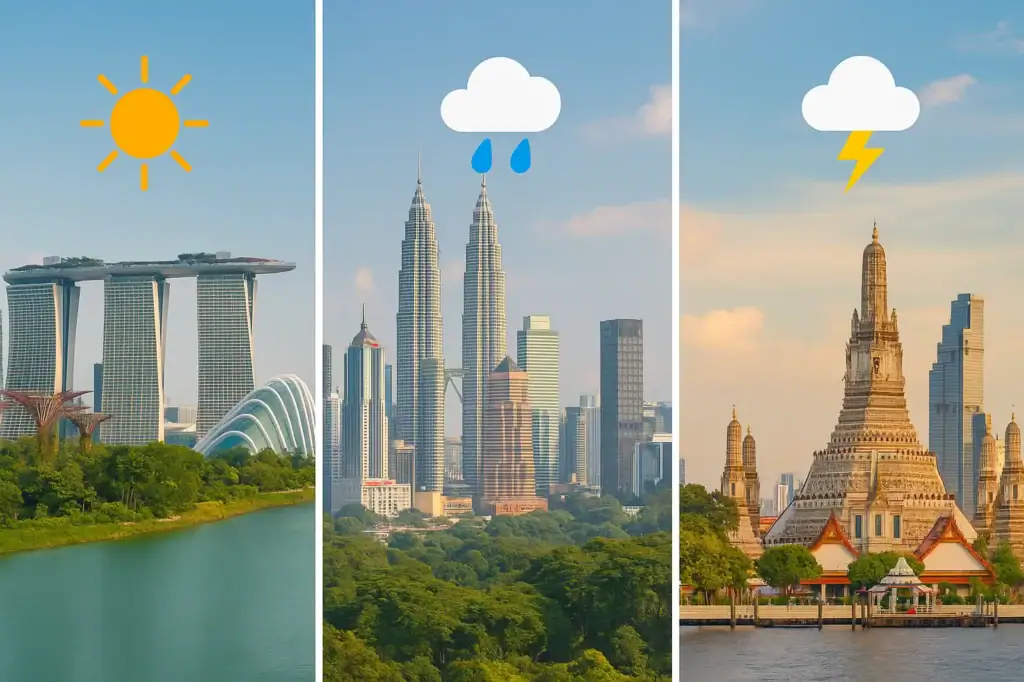
Short answer: February is often the most workable weather compromise for a trip that combines Singapore, Kuala Lumpur and Bangkok—but it is not a guarantee of dry days. Bangkok is moving from its cooler season toward the hot season, Singapore is usually past the wettest part of its northeast monsoon, and Kuala Lumpur can still have tropical showers. If your dates are fixed, plan for rain rather than trying to find a perfect month for all three cities.
Why one “best month” is misleading
The three cities do not share one weather pattern. Singapore is warm and humid all year, with rain in every month. Kuala Lumpur is also tropical, but its rainfall is shaped by Malaysia’s monsoon transitions. Bangkok has a more distinct cooler, hot and rainy cycle. A month that suits Bangkok sightseeing can still be wet in Singapore.
The practical month-by-month comparison
| When | Singapore | Kuala Lumpur | Bangkok |
|---|---|---|---|
| January–February | January is commonly wet; February is generally less rainy, but showers remain possible. | February can be a relative lull in rainfall; expect heat and occasional storms. | Generally the most comfortable period for walking; heat builds toward mid-February. |
| March–May | Warm and humid; April–May is an inter-monsoon period with thunderstorms. | April–May is a thunderstorm-prone transition period. | Hot season through roughly mid-May; schedule outdoor time early. |
| June–September | Southwest monsoon period; rain still occurs. | Southwest monsoon is relatively drier in much of Malaysia, not rain-free. | Rainy season; allow flexibility for outdoor plans. |
| October–December | October–November transition brings thunderstorms; December begins the wetter northeast-monsoon phase. | October–November is often among the wetter periods for western Peninsular Malaysia. | Rainy season usually winds down around mid-October; the cooler period follows. |
These are climate patterns, not a forecast for a particular trip. Monsoon onset and rainfall vary by year. Check the current forecast and any weather alerts shortly before departure.
Which month should you choose?
For a three-city itinerary: start with February
February is a reasonable starting point if weather is the deciding factor. It avoids Singapore’s typically wetter December–January period, is near a relative rainfall minimum in much of western Peninsular Malaysia, and is still close to Bangkok’s cooler season. This is a planning inference from the three meteorological agencies—not a promise of sunshine or lower prices.
For Bangkok first: favour the cooler part of the year
Bangkok sightseeing is generally easier from roughly mid-October to mid-February than in the hot season. But do not assume that a December or January Bangkok trip will give you dry weather in Singapore too. If Bangkok is the main stop, build the route around it and treat Singapore and Kuala Lumpur as year-round city breaks with rain backups.
For Singapore or Kuala Lumpur first: keep plans flexible
Both cities can be visited in any month. Reserve a mix of outdoor and indoor activities, leave room to swap days, and avoid interpreting “drier” as “dry.” In Kuala Lumpur, the inter-monsoon periods around April–May and October–November are especially worth watching for afternoon thunderstorms.
What about flight and hotel prices?
Weather alone does not determine a good-value trip. Airfares and hotel rates depend on your European departure city, school holidays, public holidays, events and how far ahead you book. Compare live prices for the exact dates you can travel; a generic claim that one rainy month is always cheaper is not reliable.
Plan the rest of your route
Once the dates are set, compare areas to stay in Singapore, bases for a first Malaysia trip and Bangkok neighbourhoods for first-time visitors. If the cities are connected by a longer flight itinerary, see our Europe–Asia stopover comparison.
Weather sources
Seasonal guidance is based on the Meteorological Service Singapore climate overview, METMalaysia’s climate guide and the Thai Meteorological Department’s seasons guide. Use their current forecasts for your travel dates.